
Read this guide to find out the advantages and disadvantages of wood deck vs composite to make the right decision on exterior remodeling.
Garden decks are a good example of integrating the house interior with the backyard area. When developing deck solutions for a landscape design project, consider whether composite or wooden decking is better.
The answer depends on many factors such as the funds available for the project, the main objective where it will be used, and how often it will be serviced. Both have benefits and a homeowner may have a preference as to which type they prefer.
This post looks at the differences, advantages, and disadvantages of wood deck vs composite so that you can help customers and guide them to make a proper decision.
The Basics of Wood Deck Vs Composite
Both materials are used for the same use but each is produced differently and possess unique attributes.
What is wood decking?

Using real wood decking to get the conventional timber decking look. It is recommended that you use either the hardwood or the softwood decking boards. This is mainly to prevent infestation by insects and fungus on the decking planks as well as general degradation of the wood.
What is composite decking?
WPC boards are used to imitate wooden decking and are made from a blend of wood fiber and thermosetting plastic. Cladco Composite Decking Boards are made up of a combination of 60 percent FSC-certified recycled wood fibers and 40 percent recycled polyvinyl chloride. These are combined with color tints and other preservatives to create durable and aesthetically appealing wood composite decking boards. They come in eight different colors and can be either hollow or solid.
Pros and Cons of Wood Deck Vs Composite
| Wood Deck | Composite Deck | |
| Pros | – It appears warm and looks closer to real life. – Redwood and cedar also do not warp, crack, or deteriorate when exposed to the elements. – It does not get as hot as composite decking. – Available in affordable choices.A sustainable and recyclable building material | – Has a long lifeRequires low maintenance. – Available in several hues. – Some of the producers use recycled materials. – Newer composites are very tough and do not easily stain, scratch or fade. |
| Cons | – Can split and crack if not maintained annually. – Needs to be painted, stained, and sealed every year – Certain types are prone to splitting, splintering, warping, and cracking. – Hardwoods are sometimes expensive. – Less durability compared to that of composite decking. | – Lacks some of the inherent appeal for wood. – Costs more than wooden decking. – Can become exceedingly heated.It can easily sag and bend. – The surface could be slippery when it is wet. |
Thus, although composites are usually more costly than wood, the former is expected to outlast the latter and require less maintenance. While wood is still preferred by the majority of homeowners, it does not last indefinitely. Composites can be more long-lasting, but they may not have the look and hue of a natural deck.
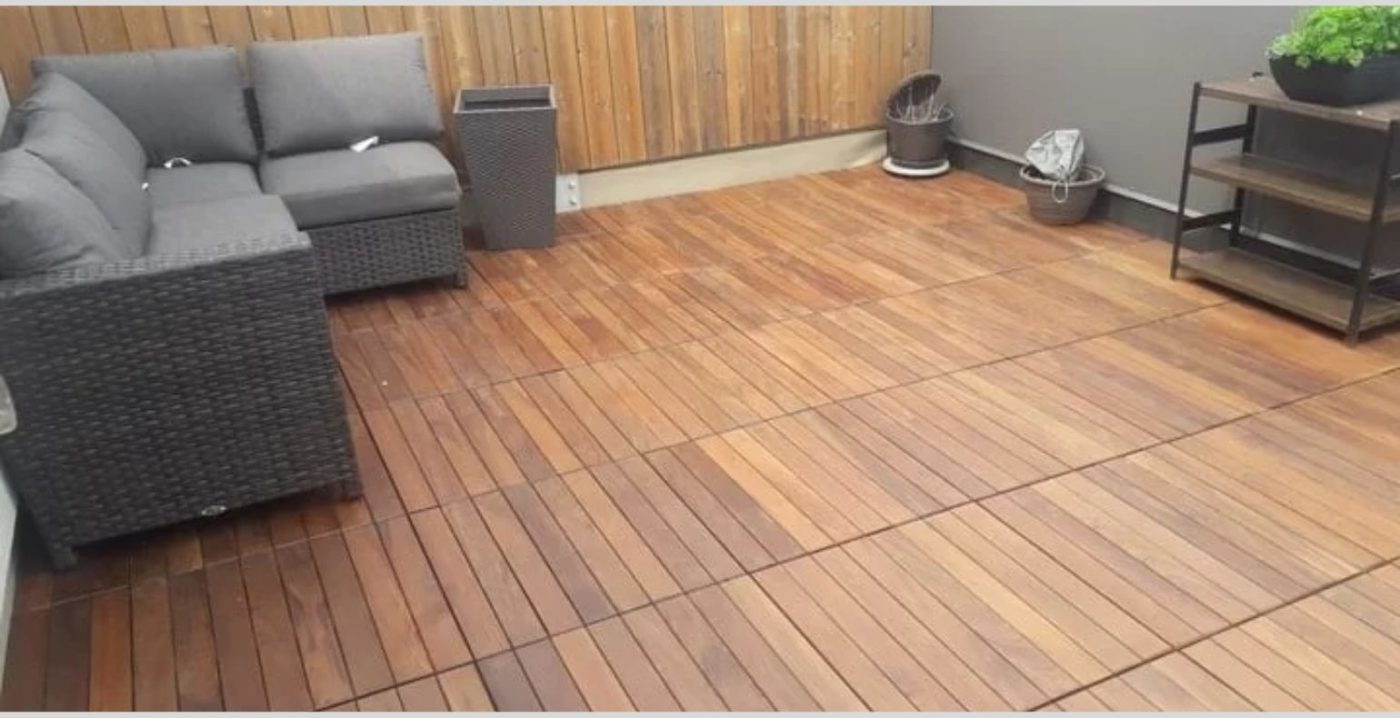
Cost Of Wood Deck Vs Composite Material
Price can be an important factor to consider when making a decision, particularly one that varies with the quality of the material. First of all, you are looking for the best bang for your buck, but at the same time, you expect it to last. The major difference between wood and composite decking materials is the initial cost versus the long-term cost.
Short Term Cost
When evaluated, at first sight, natural decks fashioned out of wood seem more economical than the others. Altogether, they are cheaper to install than composite decks most of the time. But while the cost of composite materials is relatively fixed, based mainly on your supplier, the cost of a wood deck is not only variable but highly dependent on the type of wood used and your geographical location. Namely, a pressure-treated wood deck is $15-$25 per square ft built, cedar or redwood is $30+ per ft, ipe is $50+, and composites maybe $30-$45 per ft.
By these estimates, a complete deck using 16-by-20-foot dimensions would range from $4,800 to $8,000 for pressure-treated pine, $8,000 to $9,600 or more for cedar or redwood, and $9,600 to $14,400 for composite. Ipe is substantially more costly and in many cases unaffordable to the average consumer. The use of such elements as benches and railings will bring you to a greater degree of these estimations, and the more elements you need, the greater should be your budget.
Long Term Value
Yet, the projections do not reveal where and in what manner such costs will change in the future. The durability of a deck is proportional to its value, and therefore, it may be more financially beneficial to spend more initially on a deck. In measuring their durability in terms of time before requiring maintenance or repair, it has been found that composite material lasts twice as long or even more than that of wooden solution without splintering or becoming an eyesore.
Most companies provide warranty services for up to 20 years. So, though composite costs up to twice the price of real wood, the deck itself can prove to last longer than other types of decks, meaning more long-term efficiency. Not to mention the costs of maintenance.
Maintenance and Repair Costs
Though many people focus on the immediate cost and durability when choosing the material for a deck, any person or company willing to build or construct a new deck or repair the old one should also take into consideration the expenses of maintenance and repairs. The natural wooden decks should be sanded, treated, and re-stained every one to two years depending on the climatic conditions of the area. This could be ranging from $400 to $1000 per once-a-year treatment for a high-quality stain.
Besides labor, time, and rental costs, keeping a low-end wood deck may require managing the budget well. A composite deck, on the other hand, is much easier to maintain, which entails only rinsing with water and cleaner once a year. This can be accomplished by hand or with a low-pressure power washer and it is an easy process. Unlike other types of boards, these boards are sealed before installation and therefore do not need any further treatment apart from washing them to remove mold or debris. When it comes to damages, simple and moderate damages on wood decks cost less than composite materials but the latter only needs maintenance once a year.
How to Choose Between Wood Deck Vs Composite?
It boils down to what one wants from his or her deck. And if you need a product that does not require much attention, is safe for children, and does not rot, but you are willing to sacrifice the look of natural wood, go with composite. If you value the natural look of the wood, appreciate its inherent qualities, and do not mind some extra work now and then, a wood deck is for you.
Cost should not be a deciding factor between wood deck vs composite – there are options at both ends of the monetary scale. Both types of decks can be very durable, robust, scratch-proof, and stylish if the quality solution is selected.
Likewise, those seeking an environmentally friendly option should only care about the quality of the purchased item – composite and pure wooden options exist. But please ensure that you conduct your research on your supplier and check for environmental policy. You can go as far as asking for FSC® or PEFC-certified timber which is as sustainable as it gets. If you want composite decking, look at the manufacturer’s claims to make sure that the plastic component is recycled.
This indicates that any cheap or chemically treated product – composite or timber – is likely to be environmentally detrimental!

Start your decking project today
Therefore, wood deck vs composite – which is better? No matter what your decision is, Woodspace is your people. We supply and work with DIY enthusiasts, self-builders, architects, and those responsible for specifying decks of all proportions.
Our wood decking comes in a range of resilient, renewable, and aesthetically pleasing woods from Europe, America, and other parts of the globe.
Expert deck builders at Woodspace know how to build a wood deck with precision. As much as we can, our crew ensures that the wooden decks we provide are of high quality.
If you are in a dilemma whether to choose between wood deck vs composite, our team will be glad to suggest products or give you a quote for the new wood deck at your house. Get your deck fixed before the summer season starts!
For more details, feel free to contact us:
- Facebook: Woodspace Vietnam
- Instagram: woodspace.vn
- LinkedIn: Woodspace vn
- Google Maps: Woodspace – Outdoor Furniture
We look forward to the opportunity to collaborate with you on your next project.